Clyn Star Hombre
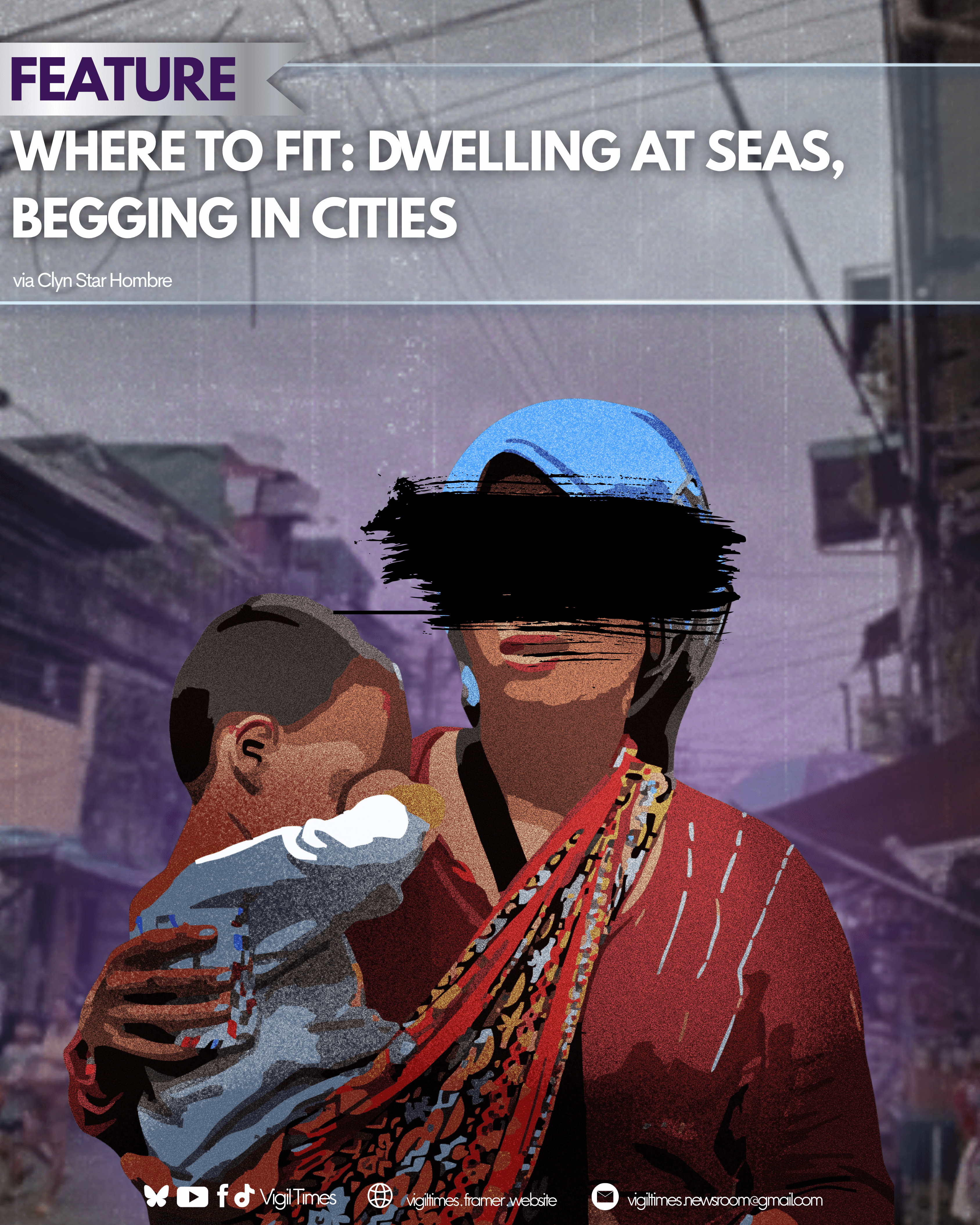
Badjaos—many often encounter them singing for coins on the jeepney, or women carrying infants while asking for alms. At least, that's what most perceive in the cities. Yet, we're only getting our feet wet with the sea dwellers community roaming the city.
Many members of their community do not use the term “Badjao,” but rather “Sama” or “Sama dilaut,” emphasizing their identity as part of a larger ethnolinguistic group from the Philippines, Malaysia, and Indonesia.
The Sama Dilaut, is a community known for their maritime skills in the archipelago of Sulu, and the coastal areas of Mindanao. A normal person can withstand a minute or two underwater without equipment, yet a Sama could free dive for 13 minutes at depths of 200 feet, according to the National Geographic.
Stateless tide or multinational flow?
Samas are nomadic by nature; their deep connection with the sea makes them great navigators, which allows them to travel between the Philippines, Malaysia, and Indonesia.
Due to these cultural factors and the fast-paced world, free shores were turned into resorts as soon as they travel out. Seafaring Samas became poor and were forced to slum into the cities.
Anna, 28, has been in the city since 2019 and is a mother of 3. She has no government ID, nor do they all have birth certificates. Hence, she or any of her children has not attained any basic freedom and benefits of the country, which includes finding a decent workplace.
“Ito lang yung alam naming hanap-buhay,” she said. Explaining that it was their only means to survive the city.
Under pressure
Last September, Aljun Cayawan, also known as Datu Agong, a prince of the Manobo Tribe Agusanon, expressed his dismay with the “Badjao Trend.”
“Discrimination is never a joke. Using the Badjao tribe as a laughingstock only adds to the wounds of prejudice. Every culture deserves respect; every people deserve dignity,” he wrote on his personal Facebook account.
On the same post, Cayawan calls for justice by tagging the National Commission on Indigenous Peoples (NCIP) and the Ministry of Indigenous Peoples’ Affairs (MIPA) in the Bangsamoro region.
Returning to nowhere
Indigenous people have their ancestral lands; hence, Samas are also entitled to their waters. Yet their tribe remains stateless, lacking legal documentation, limiting access to essential services, subjecting them to discrimination.
As systemic disadvantages rise, it leaves wavelets that become tidal when families have almost no other options, forcing them into survival strategies.
Sama Dilaut's expertise in free diving, navigating the ocean by the stars, reading currents and winds with precision, and crafting boats and coastal homes that endure the strong waves.
Systemically and stereotypically trapping their deserved standing in society to beggars and mere laughingstocks is to erase and violate their identity, rights, culture, and dignity as Filipinos.